
Tamagoyaki is a Japanese rolled omelette made by cooking thin layers of seasoned egg in a pan and rolling each layer into a soft, golden log. For this tamagoyaki recipe you whisk 3 eggs with dashi, mirin, sugar and soy sauce, cook 3 or 4 thin layers over medium heat, and roll as you go. It takes about 20 minutes, works in a regular frying pan, and makes about 6 slices. The same slices are the “tamago” on tamago nigiri at a sushi restaurant, so this page also shows how to turn it into sushi.
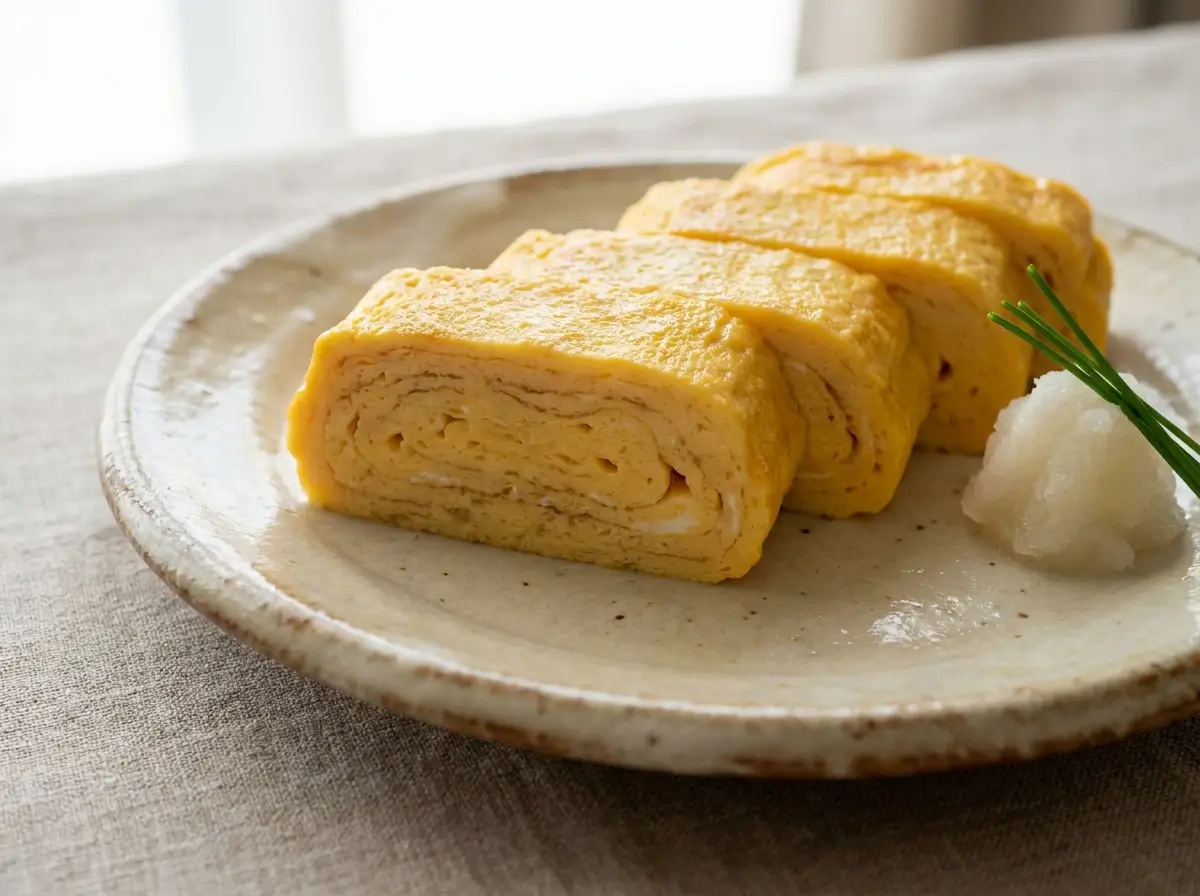
What Is Tamagoyaki?
Tamagoyaki (tamago means egg, yaki means grilled or cooked) is a Japanese omelette cooked in thin layers and rolled up. It is light, tender and barely set inside, closer to a French omelette than to a firm scrambled egg. You will find it in bento boxes, at a Japanese breakfast, as a side for lunch or dinner, and on nigiri at sushi restaurants, where it is called tamago.
Tamagoyaki Recipe: Japanese Rolled Omelette (Tamago Sushi)
- Total Time: 20 minutes
- Yield: 6 slices 1x
Description
A soft, layered Japanese rolled omelette seasoned with dashi, mirin and soy sauce, made in a regular frying pan.
Ingredients
- 3 large eggs
- 2 tbsp dashi stock (optional)
- 1 tbsp mirin
- 1 tsp sugar
- 1 tsp soy sauce, plus more for serving
- Neutral oil, for the pan
- Finely grated daikon, for serving (optional)
Instructions
- Whisk the dashi, mirin, sugar and soy sauce until the sugar dissolves. Add the eggs and whisk until smooth, without creating a lot of foam.
- Heat a nonstick pan over medium heat. Wipe a thin layer of oil over the pan with a folded paper towel.
- Drip a little egg into the pan to test the heat. It should sizzle right away. If it browns fast, lower the heat.
- Pour in about one third of the egg and tilt the pan to cover the bottom. Pop any large bubbles with chopsticks.
- When the egg is nearly set but still slightly moist on top, roll it from the far end toward you into a tight log.
- Push the roll to the far end, oil the empty part of the pan, pour in another third of the egg and lift the roll so the raw egg flows underneath. Roll the log back toward you.
- Use the last of the egg the same way, then roll one final time.
- Move the tamagoyaki to a bamboo mat or a clean kitchen towel, roll it up and press gently for a few seconds. Let it cool for a few minutes, then slice into 6 pieces.
Notes
A regular 8-inch nonstick frying pan works too. Fold the sides of each round layer toward the center before rolling. For tamago nigiri, let it cool completely and press a slice onto a small bar of sushi rice. Keeps up to 3 days in an airtight container in the fridge.
- Prep Time: 5 minutes
- Cook Time: 15 minutes
- Category: Breakfast
- Method: Pan-fried
- Cuisine: Japanese
Nutrition
- Serving Size: 1 slice
Keywords: tamagoyaki recipe, Japanese rolled omelette, tamago sushi
Tamagoyaki Ingredients
- 3 large eggs
- 2 tablespoons dashi stock (optional, see the dashimaki section below)
- 1 tablespoon mirin
- 1 teaspoon sugar
- 1 teaspoon soy sauce, plus more for serving
- Neutral oil, such as canola or vegetable oil, for the pan
- Finely grated daikon, for serving (optional)
How to Make Tamagoyaki
- Mix the egg. Whisk the dashi, mirin, sugar and soy sauce in a bowl until the sugar dissolves. Add the eggs and whisk until the mixture is smooth, without creating a lot of foam.
- Heat and oil the pan. Heat a nonstick pan over medium heat. Fold a paper towel, dip it in oil and wipe a thin layer over the pan. Hold the towel with chopsticks or tongs.
- Test the heat. Drip a little egg into the pan. It should sizzle right away. If it browns fast, lower the heat.
- Pour the first layer. Pour in about one third of the egg and tilt the pan to cover the bottom. Pop any large bubbles with chopsticks.
- Roll. When the egg is nearly set but still slightly moist on top, roll it from the far end toward you into a tight log.
- Add the next layer. Push the roll to the far end, oil the empty part of the pan, pour in another third of the egg, and lift the roll so the raw egg flows underneath it. When it is nearly set, roll the log back toward you.
- Repeat. Use the last of the egg the same way, then roll one final time.
- Shape and slice. Move the tamagoyaki to a bamboo sushi mat or a clean kitchen towel, roll it up and press gently for a few seconds to shape it. Let it cool for a few minutes, then slice it into 6 pieces.
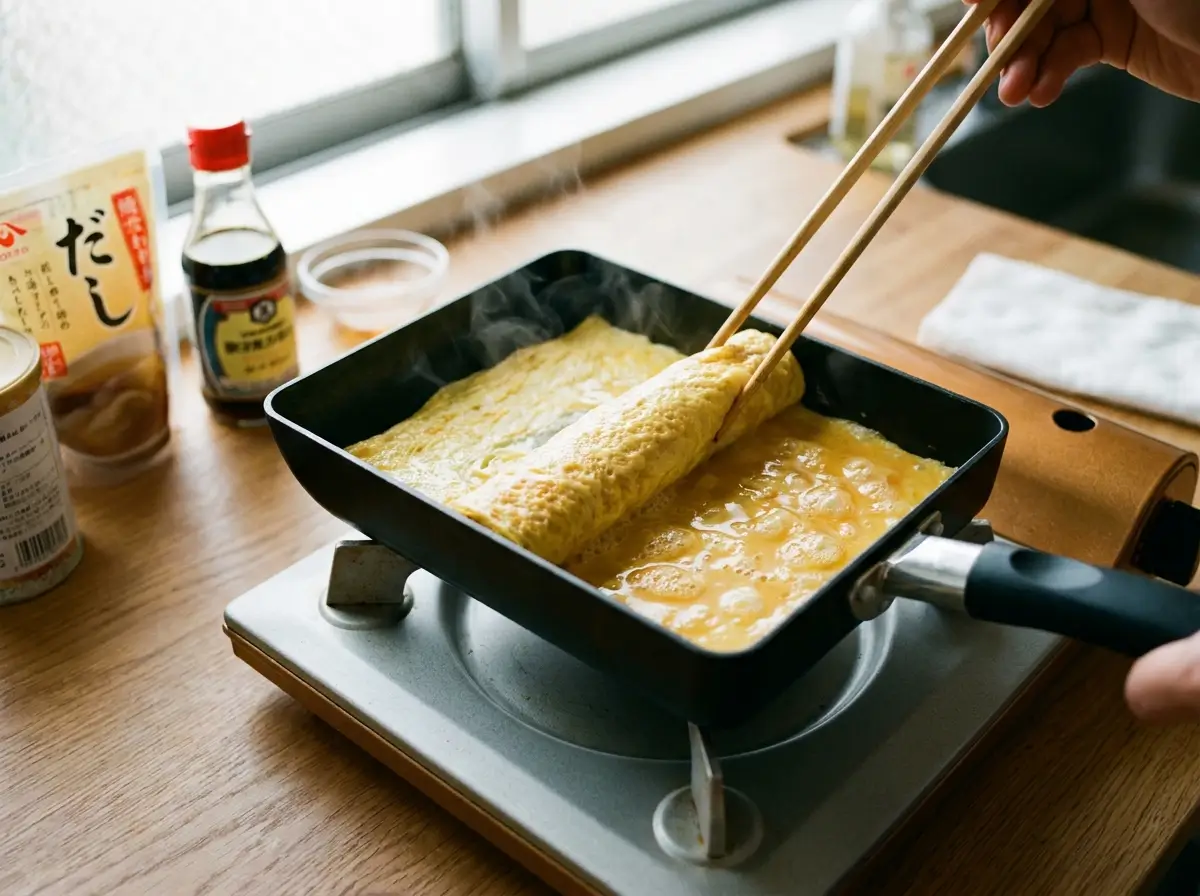
Can You Make Tamagoyaki Without a Tamagoyaki Pan?
Yes. A regular 8-inch nonstick frying pan works well. Follow the same steps, but because the pan is round, each layer will be a circle. Pour in a thin layer, and when it is nearly set, fold the two sides toward the center and then roll the egg from one side to the other. The result is a slightly shorter log with the same layers. Use medium heat, and lift the pan off the burner for a moment if the egg cooks too fast.
Which Pan Should You Use?
- Rectangular tamagoyaki pan: the traditional choice. The straight sides make it easy to roll the egg into a neat block.
- Round nonstick pan, 8 to 10 inches: a good everyday option for 3 or 4 eggs. Use a small pan so the layers stay thick enough to roll.
- Nonstick surface: the egg is delicate and sticks easily, so a nonstick pan with a thin layer of oil gives the cleanest roll.
Sweet Tamagoyaki vs Dashimaki Tamago
Classic tamagoyaki is seasoned with mirin, sugar and soy sauce, so it is lightly sweet and savory. Dashimaki tamago adds more dashi (a broth made from kelp and bonito flakes) to the egg mixture. It is juicier, more savory and a little more delicate to roll. Dashimaki is so popular that its name is often used for tamagoyaki in general. To try it, increase the dashi one spoonful at a time. The more dashi you add, the more delicate the egg is to roll.
How to Make Tamago Nigiri (Tamago Sushi)
Tamago nigiri is a slice of tamagoyaki on top of a small bar of sushi rice. It is a classic at sushi restaurants and a gentle choice if you do not eat raw fish.
- Let the tamagoyaki cool completely, then cut slices about as wide as a small bar of sushi rice.
- Wet your hands to prevent sticking, and press a small handful of sushi rice into an oval bar.
- Lay a slice of tamagoyaki on top of the rice and press lightly.
- For the traditional look, wrap a thin strip of nori around the middle to hold the egg in place.
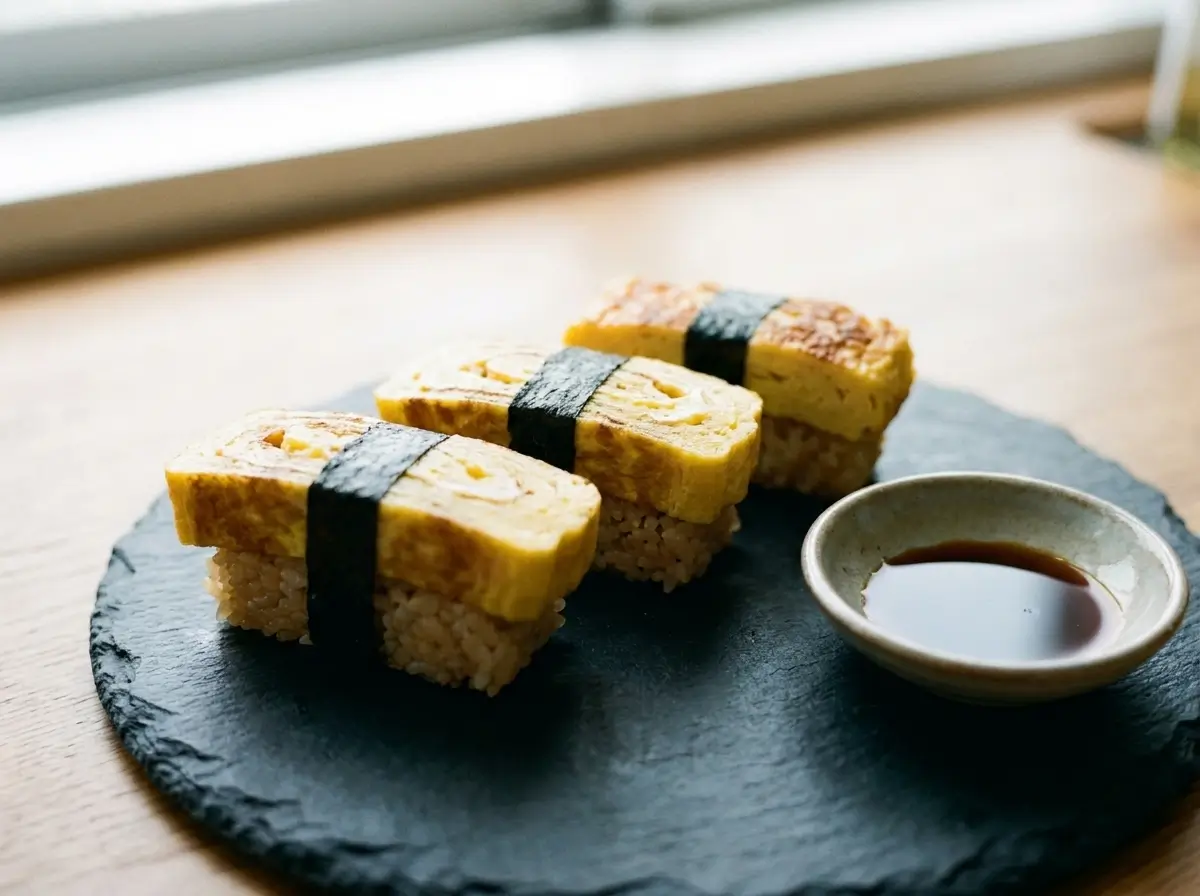
Want to understand how nigiri differs from other sushi formats? Read our guide to sushi vs sashimi vs nigiri, the difference between sashimi and nigiri, and our explainer on masago, tobiko and ikura for other toppings you will see on a sushi menu.
What to Serve with Tamagoyaki
- Sliced, with finely grated daikon and a drizzle of soy sauce.
- In a bento box with rice and vegetables.
- As part of a Japanese-style breakfast with rice and miso soup.
- On nigiri, as described above.
Storage
Let the tamagoyaki cool, then keep it in an airtight container in the refrigerator for up to 3 days. Serve it cold in a bento box, or warm it briefly in the microwave.
Frequently Asked Questions
What is tamagoyaki?
Tamagoyaki is a Japanese rolled omelette made by cooking thin layers of seasoned egg in a pan and rolling them into a log. It is tender, lightly sweet and savory, and is served in bento boxes, at breakfast and on nigiri.
Do you need a tamagoyaki pan?
No. A traditional rectangular pan makes a neat block, but a small nonstick frying pan of about 8 inches works too. Fold the sides of each round layer toward the center before rolling.
What is tamago in sushi?
Tamago is a slice of tamagoyaki, the Japanese rolled omelette, placed on a small bar of sushi rice and often held with a strip of nori. It is called tamago nigiri.
Is tamagoyaki sweet or savory?
Both. Classic tamagoyaki is seasoned with mirin, sugar and soy sauce, so it is lightly sweet and savory. Dashimaki tamago uses more dashi and tastes more savory.
How long does tamagoyaki keep?
Up to 3 days in an airtight container in the refrigerator.
Conclusion
Tamagoyaki comes down to thin layers, medium heat and a gentle roll. Start in a regular nonstick pan, slice it for a bento or breakfast, or press it onto rice for tamago nigiri. If you want to learn what else belongs on a sushi plate, begin with our sushi vs sashimi vs nigiri guide.