
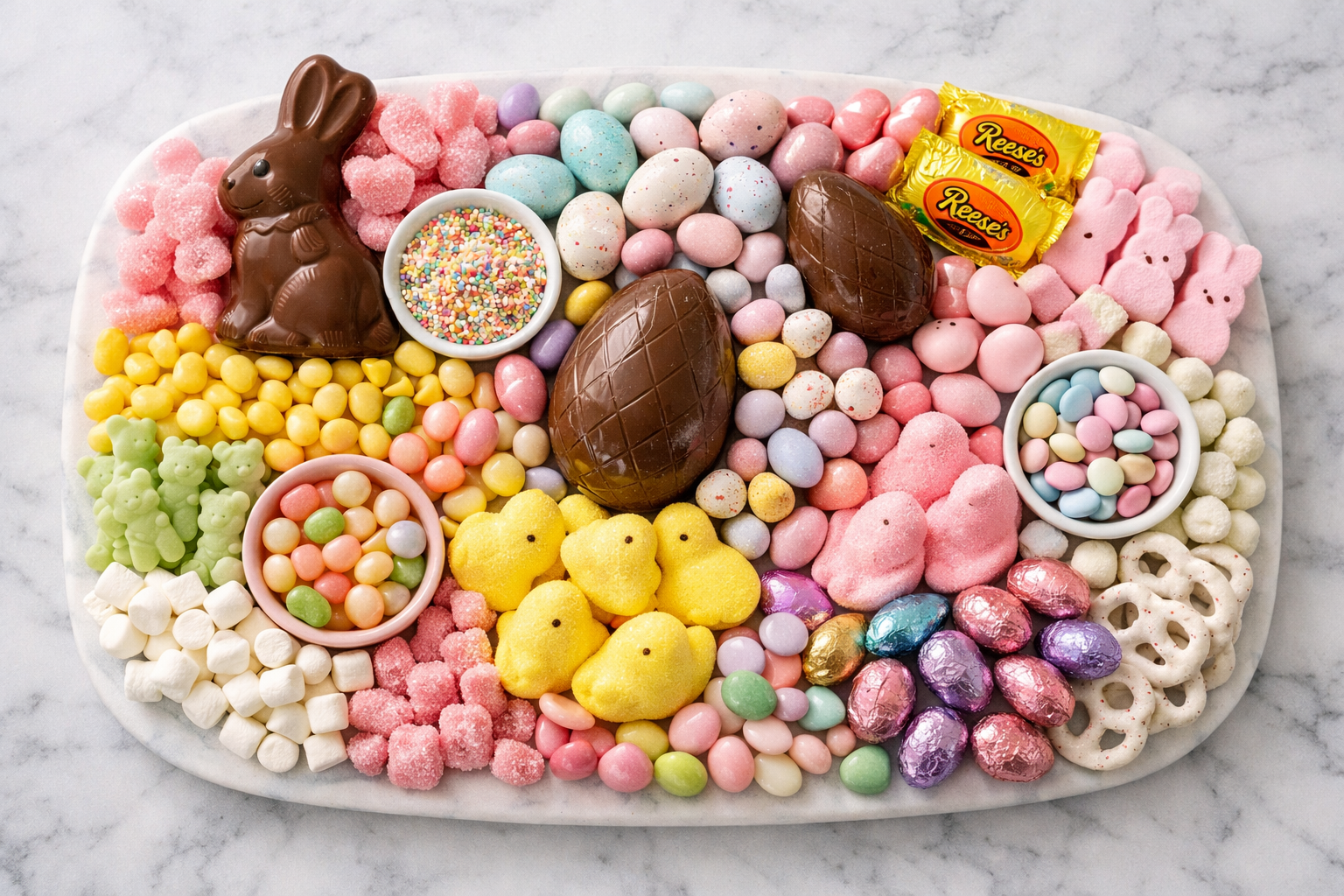
Easter candy charcuterie board — three words that have quietly taken over every Pinterest feed, party planning group, and Easter brunch table in America. And honestly? It makes sense. It’s colorful, it’s shareable, it takes less than an hour to put together, and it makes people genuinely excited the moment they walk through the door.
Whether you’re hosting a big family gathering or putting something together for a small brunch with close friends, this guide covers everything you need to know — what candy to use, how to style it like a pro, what to avoid, and how to adapt the idea depending on your budget or group size.
No baking required. No complicated steps. Just a beautiful board that looks like you planned it for weeks.
What Is an Easter Candy Charcuterie Board?
A traditional charcuterie board is built around cured meats, cheeses, and savory bites. An Easter candy charcuterie board takes that same visual format — layers, groupings, colors, textures — and replaces the savory elements entirely with candy, chocolate, and sweet treats styled around the Easter holiday.
The result is a dessert board that looks almost too good to eat. Pastel-colored candies, chocolate eggs, gummy chicks, jelly beans, and seasonal sweets are arranged in a way that’s visually stunning and completely grab-and-go friendly.
It works for Easter morning, Easter brunch, Easter egg hunts, school parties, office celebrations, and family dinners alike.
Why Everyone Is Building Easter Candy Boards Right Now
The candy charcuterie board trend has been growing steadily for a few years, and Easter is one of the best holidays for it — arguably even better than Christmas or Valentine’s Day. Here’s why:
- Easter is built on candy. From jelly beans to Cadbury eggs, Easter already has one of the strongest candy identities of any American holiday.
- The color palette is ready-made. Pastels — pale yellow, lavender, mint green, soft pink — are both festive and naturally photogenic.
- It’s endlessly flexible. You can build a board for $15 or $60. You can go all-chocolate or all-gummy. You can keep it simple or go full Pinterest.
- It’s interactive. People love picking at a board. It invites grazing, conversation, and connection in a way that a dessert plate just doesn’t.
If you’ve ever built a Galentine’s charcuterie board or a holiday dessert spread, the Easter version follows the exact same logic — seasonal color palette, layered textures, and intentional variety.
What Candy Goes on an Easter Charcuterie Board?
This is where most people get stuck. The good news is that there’s no strict rulebook — but there is a framework that tends to produce the best-looking boards.
Think in five categories: anchor sweets, seasonal candy, chocolate, gummies, and fillers. The table below breaks down popular options by category and visual impact.
| Category | Top Picks | Visual Impact |
|---|---|---|
| Anchor Sweets | Cadbury Creme Eggs, large chocolate bunnies, Reese’s Eggs | High — creates focal points |
| Seasonal Candy | Robin Eggs (Whoppers), Starburst Jellybeans, Brach’s Classic Jelly Beans | High — pastel colors dominate |
| Chocolate | Hershey’s Kisses (pastel), M&M’s Easter mix, Lindt Easter eggs | Medium-high — adds richness |
| Gummies | Gummy bears, Peeps, gummy chicks, sour worms | Medium — adds height and fun |
| Fillers | Mini marshmallows, white chocolate chips, pastel sprinkles, yogurt-covered raisins | Low — fills gaps beautifully |
Each category serves a different visual and textural purpose. Your anchor sweets give the board structure and weight. Your fillers are what keep the board from looking sparse or patchy. Use the table above as a starting checklist rather than a strict rule — your board should reflect what you and your family actually enjoy eating.
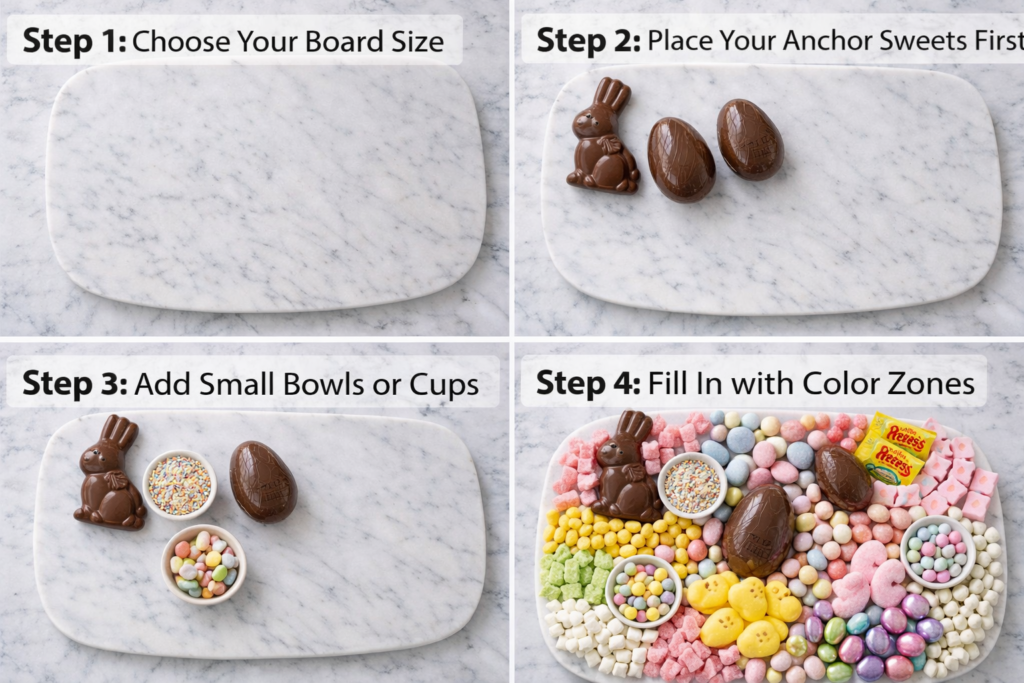
How to Build Your Easter Candy Charcuterie Board: Step by Step
You don’t need a specific board size or a special kit. A wooden cutting board, a round slate board, a marble cheese board, or even a simple ceramic platter all work well. For Easter specifically, a pastel-colored serving tray or an egg-shaped board can add extra festive flair.
Step 1 — Choose Your Board Size
For a group of 6–8 people, a 12×18-inch board is typically a good starting size. For smaller gatherings of 2–4, a 9×13 or even a small round board works well. The board should feel full and lush — too much empty space makes the arrangement look unfinished.
Step 2 — Place Your Anchor Sweets First
Start with your largest, most visually striking items. These are your focal points — chocolate bunnies, large Cadbury eggs, or a group of Reese’s Eggs arranged together. Place them in two or three spots across the board, not all in one corner. These placements drive where everything else goes.
Step 3 — Add Bowls or Small Cups (Optional but Recommended)
Small ramekins, silicone cups, or mini paper bowls give you a way to corral loose candy like jelly beans, M&M’s, or yogurt-covered treats. They also add height variation, which makes the board look more dimensional in photos.
Step 4 — Fill In with Color Zones
Group similar colors together, then alternate. Pale yellow next to lavender next to soft pink creates a natural Easter palette. Avoid clustering too many colors of the same family in one spot — the visual contrast is what makes the board pop.
Step 5 — Fill Every Gap with Your Fillers
Once your major candy placements are done, use mini marshmallows, pastel sprinkles, or white chocolate chips to fill in any visible empty spaces. This is the step most people skip, and it’s the difference between a board that looks “okay” and one that looks genuinely impressive.
Step 6 — Add Final Details
Scatter a few Easter-themed picks or small decorative elements if you have them — a tiny chick figurine, a small nest with chocolate eggs, pastel ribbon. These details are optional, but they elevate the presentation significantly.
Easter Candy Charcuterie Board Ideas: Themes to Try
One of the best things about building an Easter candy board is that you can adapt it to a specific theme without much effort. Here are a few ideas worth trying.
Classic Easter Pastel Board — Stick entirely to pastel-colored candy: jelly beans, Peeps, pastel M&M’s, white chocolate eggs, and lavender gummy bears. Keep the color story simple and cohesive.
Chocolate Lover’s Easter Board — Anchor everything around chocolate: Cadbury Creme Eggs, Reese’s Eggs, Hershey’s pastel Kisses, Kit Kats, and Lindt mini eggs. Add cocoa almonds and chocolate-covered pretzels for texture.
Easter Fruit and Candy Charcuterie Board — Combine fresh fruit with candy for a board that feels a little more balanced. Strawberries, mandarin orange segments, raspberries, and green grapes pair beautifully with jelly beans and chocolate eggs. The natural colors of the fruit complement the pastel candy palette, and the contrast between fresh and sweet tends to go over very well with adults and kids alike. If you want to anchor the board further, a small easy chocolate fondue board setup on the side gives guests a dipping option that makes everything more interactive.
Sour and Sweet Kids’ Board — Lean into the candies kids actually go crazy for: Sour Patch Kids in spring colors, gummy worms, Nerds Rope, Swedish Fish, and Airheads. Bright, energetic, and guaranteed to be the first board emptied at any Easter egg hunt.
Small Easter Candy Charcuterie Board for Intimate Gatherings
Not every Easter celebration is a big production. Sometimes it’s just a few people, a quiet Sunday brunch, and a small sweet touch to mark the occasion. A small Easter candy charcuterie board — built on a 9-inch round board or a small wooden paddle — can be just as beautiful as a large spread.
For a small board, keep it to 5–7 candy types instead of 10–12. Focus on variety in texture rather than variety in quantity: one gummy element, one chocolate element, one jelly-type candy, one seasonal standout (like Robin Eggs), and a small filler. That’s genuinely enough to create a beautiful, cohesive look.
Pair it with a simple spring brunch spread and it feels intentional and thoughtful rather than minimal.
The 3-3-3 Rule for Charcuterie — Does It Apply to Candy Boards?
The 3-3-3 rule is a popular guideline in traditional savory charcuterie: 3 cheeses, 3 meats, 3 accompaniments. It’s designed to create variety without overwhelming the board or the guest.
For candy charcuterie boards, a loose version of this principle can actually be helpful. A suggested adaptation for Easter candy boards might look like: 3 types of candy by texture (chocolate, gummy, hard/crunchy), 3 color tones (pastel pink, yellow, and purple, for example), and 3 sizes of items (large anchors, medium fillers, and small scatter pieces).
This isn’t a rigid rule — it’s more of a useful mental checklist when you feel like your board is missing something or looking a little flat. If everything is the same size, the board tends to look monotonous. If everything is the same color, it blends together. The 3-3-3 principle simply pushes you toward variety in each of those three directions.
Most Popular Easter Candies to Use on Your Board
Easter candy is one of the most recognizable seasonal candy categories in the U.S., and certain items appear on boards again and again for good reason — they’re widely available, visually strong, and genuinely loved.
The Easter candies that show up on boards most often in the U.S. include Reese’s Peanut Butter Eggs, Cadbury Creme Eggs, Starburst Jellybeans, Hershey’s Kisses in pastel foils, Robin Eggs (Whoppers), Peeps, and M&M’s in Easter-themed mixes. These tend to be the most recognized and reliably crowd-pleasing choices for a board.
A few additional options that photograph particularly well and tend to elevate the overall look:
- Lindt Gold Bunny — a classic Easter item that works beautifully as a tall anchor piece
- Pastel Jordan Almonds — add an elegant, old-fashioned touch and photograph beautifully
- Chocolate-covered pretzels in Easter colors — add saltiness and crunch
- Yogurt-covered raisins — soft, pearl-like appearance that fills gaps naturally
- Pastel Hershey’s Kisses — versatile, easy to scatter, and universally liked
5 Things to Avoid on an Easter Candy Charcuterie Board
Most of the advice about building a great candy board focuses on what to add. But knowing what to avoid saves you time, money, and a lot of frustration when the board doesn’t come together the way you pictured.
1. Mixing too many colors without a plan. Bright red, deep purple, neon green, and hot orange together look chaotic. Easter boards look best when you choose a palette (pastels, or pastels with one bold accent) and stick to it.
2. Using only one texture. A board made entirely of gummies, or entirely of hard candy, feels flat and uninteresting to eat. Variety in texture — soft, crunchy, chewy, melt-in-your-mouth — is what makes grazing a board genuinely enjoyable.
3. Ignoring scale. Placing very small candies next to very small candies with nothing large to anchor the eye makes the board look unfinished. Always have at least two or three large pieces that give the board visual weight.
4. Unwrapping too much in advance. Some Easter candies — especially chocolate — can start to look dull or develop a slight white bloom if left at room temperature too long before guests arrive. Assemble the board within 1–2 hours of serving when possible, and keep it in a cool area.
5. Forgetting serving tools. If you’re including jelly beans or loose candy in open sections (not bowls), having small tongs or a serving spoon nearby makes the board feel more intentional and keeps it from getting picked through with fingers immediately. Small candy scoops are inexpensive and add a nice touch.
DIY Easter Candy Charcuterie Board on a Budget
One of the most common concerns people have before building a candy board is cost. The good news is that an Easter candy charcuterie board can look genuinely stunning on a modest budget — especially in spring, when Easter candy is widely available at grocery stores, Target, Walmart, and dollar stores at very reasonable prices.
Tips for keeping costs down:
- Buy in bulk bags and use small portions. A large bag of Starburst Jellybeans costs about the same as a small bag, and it fills multiple areas of the board with plenty left over.
- Mix name-brand anchors with store-brand fillers. One or two recognizable name-brand items (a Lindt bunny, a bag of Reese’s Eggs) combined with store-brand or generic jelly beans and pastel chocolates gives you the visual impact of a premium board without the premium cost.
- Use the dollar section. Dollar Tree and Target’s dollar section reliably carry Easter candy, small decorative picks, and pastel cups in the weeks before Easter.
- Skip the specialty board. A wooden cutting board you already own, a ceramic platter, or even a sheet of kraft paper on a table works just as well as a purchased charcuterie board.
A well-built Easter candy board for 6–8 people can often be assembled for roughly $20 to $35, depending on your candy choices and where you shop. Prices change from year to year, so check store flyers before you buy.
Frequently Asked Questions
What is the 3-3-3 rule for charcuterie?
The 3-3-3 rule is a classic guide for savory boards: 3 cheeses, 3 meats, and 3 accompaniments. For a candy charcuterie board, a similar principle can be loosely applied by choosing 3 candy textures (chocolate, gummy, crunchy), 3 color tones, and 3 size ranges for your pieces. It's a helpful starting framework, but not a rigid requirement.
What are the most popular Easter candies?
Some of the most popular Easter candies in the U.S. include Reese's Peanut Butter Eggs, Cadbury Creme Eggs, Starburst Jellybeans, Peeps, Robin Eggs (malted milk Whoppers), M&M's Easter mixes, and Hershey's pastel Kisses. These tend to be widely available and reliably crowd-pleasing on any Easter board.
What to put on a charcuterie board for Easter?
For an Easter candy charcuterie board, aim to include a mix of chocolate (like Cadbury eggs or Reese's Eggs), seasonal candy (jelly beans, Robin Eggs, Peeps), gummies or soft candy, and loose fillers like mini marshmallows or pastel sprinkles. Adding fresh fruit like strawberries and raspberries is also a popular option for a more balanced, adult-friendly board.
What are 5 things to avoid on a charcuterie board?
On an Easter candy charcuterie board, try to avoid: mixing clashing colors without a palette plan, using only one texture, neglecting scale (no large anchor pieces), unwrapping chocolate too far in advance, and forgetting to include small serving tools for loose candy.
Can I make this board ahead of time?
It's generally recommended to assemble the board within 1–2 hours of serving, particularly for chocolate items that can be affected by temperature. The candy picks, fillers, and loose elements can be pre-portioned the night before to speed up assembly day.
What board or tray should I use?
Any flat serving surface works — a wooden cutting board, marble slab, round slate board, ceramic platter, or even a sheet tray lined with parchment paper. For Easter specifically, a pastel-colored tray or an egg-shaped board can add an extra festive element without any additional effort.
Final Thoughts
An Easter candy charcuterie board doesn’t require culinary skill, a big budget, or hours of preparation. What it requires is a little intentionality — choosing a color palette, mixing textures, giving the board visual anchors, and filling in the gaps. That’s genuinely it.
Once you build your first one, you’ll likely find yourself reaching for this idea every Easter after that. It’s the kind of thing that photographs beautifully, impresses guests immediately, and disappears fast — which is usually the best sign that something worked exactly as intended.
Print
Easter Candy Charcuterie Board: How to Build the Most Festive Spread This Spring
- Total Time: 30 minutes
- Yield: 6–8 servings
Description
A colorful, shareable Easter candy charcuterie board packed with chocolate eggs, gummies, jelly beans, and pastel treats — no baking required and perfect for any spring gathering.
Ingredients
- Cadbury Creme Eggs
- Chocolate bunnies
- Reese’s Eggs
- Robin Eggs (malted milk balls)
- Starburst Jellybeans
- Brach’s Jelly Beans
- Pastel M&M’s
- Hershey’s Kisses (pastel)
- Lindt mini eggs
- Peeps
- Gummy bears or gummy chicks
- Sour candies (optional)
- Mini marshmallows
- White chocolate chips
- Yogurt-covered raisins
- Pastel sprinkles
Instructions
- Choose a serving board or platter appropriate for your group size.
- Place large anchor candies like chocolate bunnies and creme eggs across the board.
- Add small bowls or cups for loose candies like jelly beans and M&M’s.
- Arrange candies in color zones using pastel shades for visual appeal.
- Group similar textures together while alternating colors.
- Fill empty spaces with mini marshmallows, sprinkles, or small candies.
- Add decorative Easter elements like chicks or themed picks (optional).
- Serve immediately or within 1–2 hours for best freshness.
Notes
Stick to a pastel color palette for best visual results. Mix textures like chocolate, gummy, and crunchy for variety. Assemble close to serving time to keep candy fresh.
- Prep Time: 30 minutes
- Cook Time: 0 minutes
- Category: Dessert
- Method: No Bake
- Cuisine: American
Nutrition
- Serving Size: 1 portion
- Calories: 380
- Sugar: 45g
- Sodium: 120mg
- Fat: 18g
- Saturated Fat: 10g
- Unsaturated Fat: 6g
- Trans Fat: 0g
- Carbohydrates: 55g
- Fiber: 1g
- Protein: 4g
- Cholesterol: 15mg
Keywords: easter candy charcuterie board, easter dessert board, candy board, easter treats, no bake dessert